The below page contains excerpts from an article published
by Dr. Jeffrey M. Masters
Chief Meteorologist, The Weather Underground, Inc.
The disaster film epic, The Day After Tomorrow™, depicts a world where global warming triggers an abrupt climate change, creating a global superstorm that unleashes unimaginable worldwide weather disasters. In the span of just a few days, tornados devastate Los Angeles, huge hail pounds Tokyo, and colossal storm surge waves and blizzards whip New York. Could it really happen? Could global warming really cause such incredible disasters?
Like much science fiction, The Day After Tomorrow™ is based on some solid scientific fact. Recent scientific discoveries show that the present day climate is unusually stable, and that "normal" climate for Earth is the climate of frequent extreme jumps--like a light switch flicking on and off. Thus, the popular conception that global warming will lead to a slow and steady increase in temperature that humans can readily adapt to may be incorrect. Global warming could push the climate system past a threshold where a sudden, irreversible climate shift would occur. This would most likely happen if the increased precipitation and glacial melt water from global warming could flood the North Atlantic with enough fresh water to slow down or even halt the mighty Gulf Stream ocean current. Without the Gulf Stream pumping warm, tropical water to the North Atlantic, average temperatures would cool in Europe and North America by 5°F or more in just a few years--not enough to trigger a full-fledged ice age, but enough cooling to bring snows in June and killing frosts in July and August to New England and northern Europe, such as occurred in the famed "year without a summer" in 1816. In addition, shifts in the jet stream pattern would bring about severe droughts and damaging floods in regions unaccustomed to such events, greatly straining global food and water supplies. Climate experts consider a sudden global warming-induced climate shift unlikely in the next 100 years, but do acknowledge their computer models are too crude to know just what the probabilities are.
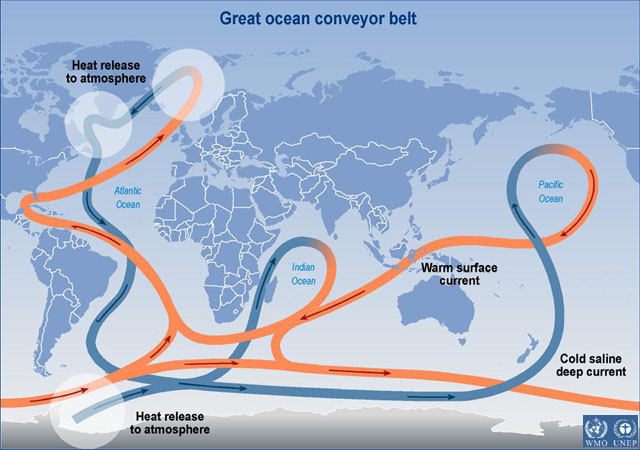
But no, a sudden global warming-induced climate shift could not cause the kind of instant wild weather mayhem depicted in the movie. In this respect, The Day After Tomorrow is science Fiction with a capital "F". With this said there is some use for this movie in the classroom. During the first twenty minutes we are introduced to Global Ocean Currents and discussion on how these currents move the heat around the earth occurs. This is true science as the picture below shows.
After this there is evidence of "out of the ordinary" weather patterns. Major climatic changes can occur when there is a change in any number of global cycles.
Other areas in the movie that we will look at with a science eye include the following claims.
# 1The superstorm sucks vast quantities of frigid upper atmospheric air down to the surface, flash freezing any living thing caught outside. However, any graduate of a high school physics course could tell you that the air would warm on its descent in response to the requirements of the Ideal Gas Law, and would never be able to flash freeze anything. One scientist in the movie does remember his high school physics and asks, "But wouldn't the air warm as it descends?" But the senior scientist replies, "No, it's moving too fast!" Sorry, guy, but the Ideal Gas Law applies no matter how fast the air is moving. If you were on my thesis committee, I'd kick you off.
# 2 Clusters of thunderstorms cannot merge together to form a continent-scale blizzard with a calm eye over land. Huge storms with calm eyes can only happen over the oceans. These storms are called hurricanes, and require that the core of the storm be over warm ocean waters in order to utilize the powerful latent heat energy that water vapor gives up when it condenses into rain. And the laws of physics do not allow these type of storms to create blizzard conditions, only heavy rain.
# 3 A 300-foot high storm surge whipped up by the intense winds of the superstorm smashes through Manhattan. There's a little problem here--the winds needed to create a storm surge of this magnitude are probably at least twice the speed of sound (1200 mph), yet there is little apparent wind on the ocean's surface as the wave smashes ashore.
# 4 The superstorm is shown in many scenes rotating clockwise, and in other scenes counter-clockwise. Oops, all large-scale storm systems in the Northern Hemisphere must rotate counter-clockwise, thanks to one of the laws of physics on a rotating planet called the Coriolis force.
So sit back and enjoy this great movie and all of its special effects. At the same time get a laugh or three in when you know the real science behind the storm!!
Have a great day!